
Your trendy AI pricing model is wrong
And by "wrong" we mean "misaligned to value and hard to explain"
Ian Clark · July 29, 2026 · 5 min read
Welcome back to Composed, where we provide a bite-sized piece of monetization strategy each week.
If you’re not a subscriber yet, hit the button below to keep getting these emails delivered to your inbox.
The BLUF (Bottom Line Up Front)
Pricing for tokens and outcomes are trendy AI pricing models. Don’t follow the trend please!
Tokens are cost+ pricing by another name, and outcomes-based pricing is usually a marketing stunt. Price to willingness-to-pay instead.
Don’t forget about the much-maligned-seat-based-pricing! Sometimes it still works!

AI Pricing Trends
It seems that every day I am waking up to a new “think-fluencer” on the internet talking about how the introduction of AI changes how we should think about pricing. We have written extensively on this topic with the hard fought opinion of “no it does not”. See How to Price Generative AI or our series on Clay’s new pricing for more of our hot takes.
There are two tends that continue to pop up in my feed: token-based pricing and outcomes-based pricing. You know what everyone still hates? Seats.
Let’s talk about it.
Token-Based Pricing
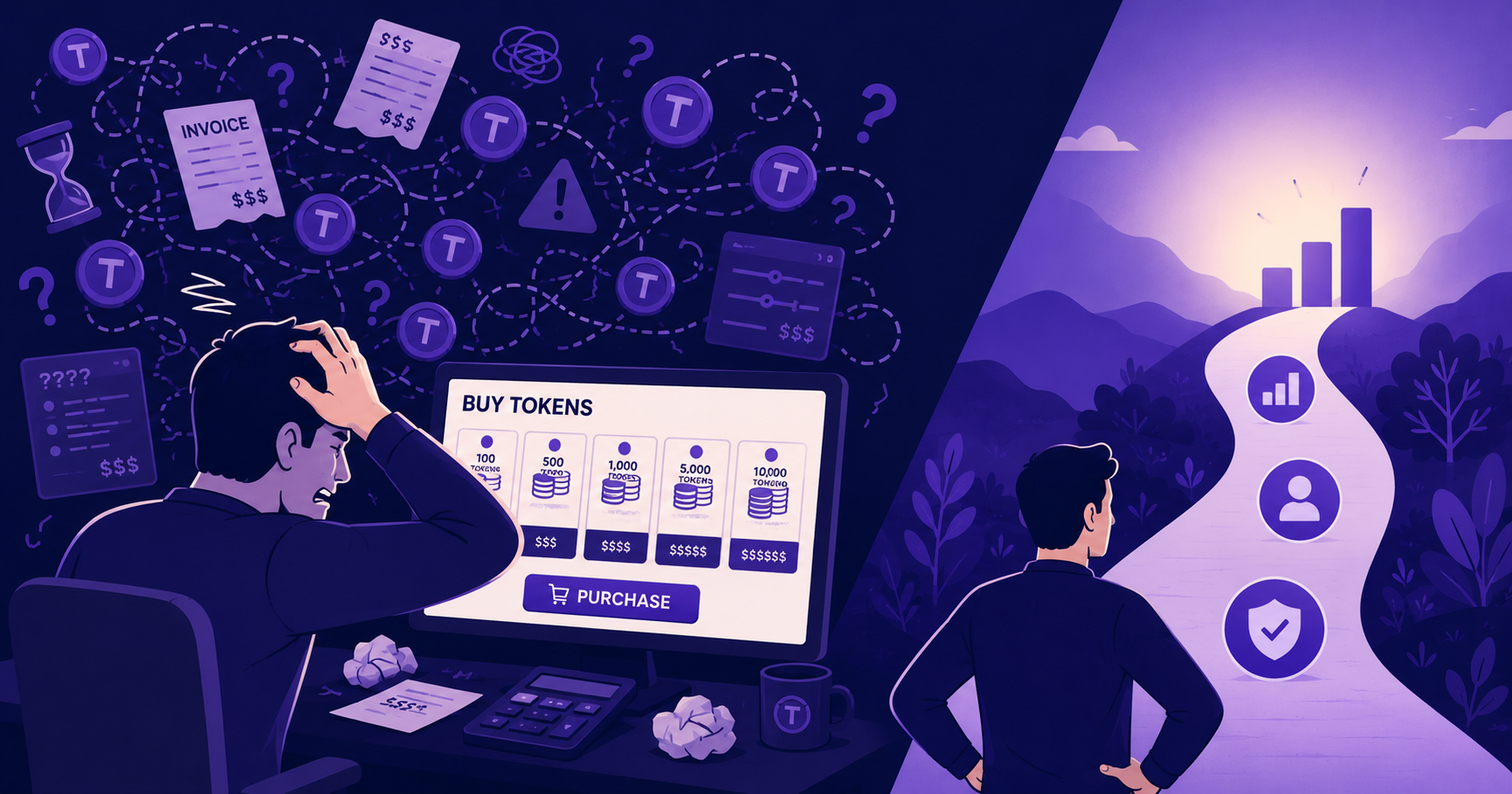
Token-based pricing should be familiar to users of the popular AI coding tool Cursor. Each action that the AI takes, whether reading, writing, or outputting code, requires a certain number of tokens. Then based on the cost of those tokens from the underlying model provider (e.g. Anthropic), the customer is billed some variable rate. If that sounds complicated, wait till you see their actual pricing…

I had to cut off the screenshot because it wouldn’t fit in this newsletter
Tokens are cost-plus pricing, a practice which we at Crescendo vehemently oppose. See Why Your Costs Don’t Matter, a post we wrote about…why your costs don’t matter.
The problem with cost-plus pricing is that by pricing to your own costs, you sacrifice total margin in exchange for minimizing margin variation among customers. There are plenty of examples of companies that sacrifice margin variation in exchange for total revenue: razors and razor blades, printers and ink, and video game consoles come to mind. Each of these products high margin variation, which is precisely how they maximize total margin. We never believe that sacrificing total margin in exchange for consistent margin across products and customers is worthwhile trade-off. But back to AI pricing…
Outcomes-Based Pricing
The poster child for outcomes-based pricing is Sierra, an AI customer service rep that charges for “resolved interactions”. The team at Sierra has done an absolute boat load of PR surrounding their pricing model (see here, here, and here)

Sierra’s PR team pushing the outcomes-based pricing narrative
Many companies are following Sierra’s path, switching their usage-based (or seat-based) pricing models to only bill when the intended outcome is achieved.


It’s not that we at Crescendo aren’t fans of this type of pricing. We often recommend shifting your price metric toward something that is, in fact, closer to the value actually delivered.
We just think that this is not outcomes-based pricing, but usage-based pricing. No one would argue that Google charging for “pay per click” is “outcomes-based” while Facebook charging for “pay per impression” is not. It’s just farther down the sales funnel.
My take? The only people really charging for outcomes are personal injury lawyers.

True outcomes-based pricing
A Surprisingly Good AI Pricing Strategy
We are not here to defend any one price metric. You need to pick the metric that works best for your business. That said, everyone seems to be hating on seat-based pricing these days. But sometimes, it’s actually the optimal way to charge for AI.
Seat-based pricing is ultimately charging for access. What percentage of your company (or sales team or other group) do you want to have access to this tool? Access can be a perfectly reasonable measure of value - after all, we often measure AI adoption by the number of users in a company that are actually utilizing it.
Access-based pricing metrics1 work best when AI is augmenting your existing team members. We’ve seen this work with AI sales proposal generation augmenting an existing sales force, or AI accounting agents augmenting financial operations staff. It also works wonderfully when you sell multiple AI products or modules to different customers, each augmenting the user in a different way.
Where access-based pricing fails is exactly the same time when any price metric fails: infeasibility and poor connection to value.
If your users have a high likelihood of sharing logins to the AI, then you cannot feasibly gate access, which breaks the price metric. For example, imagine you have a marketing collateral generator, and the entire marketing team shares one license - in that case, willingness-to-pay is complete disconnected from license count.
By contrast, CRM software is rarely every shared across salespeople, primarily because salespeople want credit for their deals! Having a “basic” license without AI and a “premium” license with AI is a pricing model that scales nicely with value and with wallet size.
Conclusion: How to Pick an AI Price Metric
The same way you pick any price metric.
Brainstorm a list of 10-20 potential metrics. Make sure to include metrics from multiple “categories” such as usage, access, capacity, outcomes, or demographics.
Assess the metrics across 4 success criteria - a good price metric is valuable, feasible, communicable, and segmentable.
Validate your assessment above using data analysis, customer interviews, or market studies.
Build the new pricing.2
Roll out the new pricing gradually and adjust as real customer preferences start to come in.
Get in touch
Crescendo works with medium-sized software companies to improve their pricing, packaging, and promotion strategies. If you’d like to book a quick consult, reach out at info@crescendo.partners or schedule time via the button below.
1 I’ll stop using the word “seats” to limit the number of aneurisms online
2 I understand this is hard and I’m ignoring your complaints for now…