
Should you underprice or overprice?
A introduction to monetization strategy
Ian Clark · August 4, 2026 · 7 min read
Welcome back to Composed, where we provide a bite-sized piece of monetization strategy each week.
If you’re not a subscriber yet, hit the button below to keep getting these emails delivered to your inbox.
The BLUF (Bottom Line Up Front)
Monetization strategy involves deliberately over or under charging a particular product or segment
Executing either an adoption or penetration strategy definitionally will cost you revenue
But it might be worth it, only in specific circumstances!
We’re launching a new series!
This month we will be launching a new 7-part series on a Monetization Strategy Deep Dive. We’ll publish more frequently too, so check back for 1-2 posts each week.
At the end of the series, we’ll also be offering a publicly available tool so you can gut check whether a particular monetization strategy is right for you.
What is Monetization Strategy?
Have you ever heard any of the following in a board room:
“Charge less now, grab market share, monetize later.”
“We don’t want to be perceived as ‘low priced.’ It might hurt our brand.”
“We should charge less so we can steal customers from our competitor!”
“Give the product away for free for the first year. That will get customers hooked!”
Each of the quotes above illustrate a deep cut of pricing known as “monetization strategy.” Unfortunately, each of the sentences above is a representation of lazy, all-else-equal, thinking. Underneath each strategy is a hypothetical benefit, with very real (but underdiscussed) costs.
Let’s dig in.
The Goal of Pricing
Much of the time when we write about pricing, we make a very large assumption about your business’ goals. We assume that you are trying to make money…
Specifically, we assume that you are trying to maximize revenue, across each product line and each market segment.
However, as anyone who has ever studied business will know, making money everywhere right now is not always the best strategy. Sometimes, the optimal strategy involves underpricing to win the market. Famous examples you might know are Amazon, Facebook, and your annoying landlord.
Alternatively, you might want to overprice so that you can protect your margins and slowly release the product into the market. Pharmaceuticals, Birkin Bags, and airport lounges all employ this strategy with great success.
So - what is Monetization Strategy? It is the deliberate decision to do the following:
Under or over price your product (or customer segment)…
Thereby sacrificing revenue…
In exchange for a more valuable strategic position.
Monetization strategy is both the first and last thing we talk about with our companies: it both sets the stage for all future decisions and also overwrites any good pricing work we may have done1
The 3 Monetization Strategies
Despite what Wikipedia2 says, there are there only 3 strategies you can employ when pricing:
Adoption3 Strategy —> underprice and sell your product to more customers
Skimming Strategy —> overprice and sell your product to fewer customers
Default Strategy —> price optimally and maximize revenue
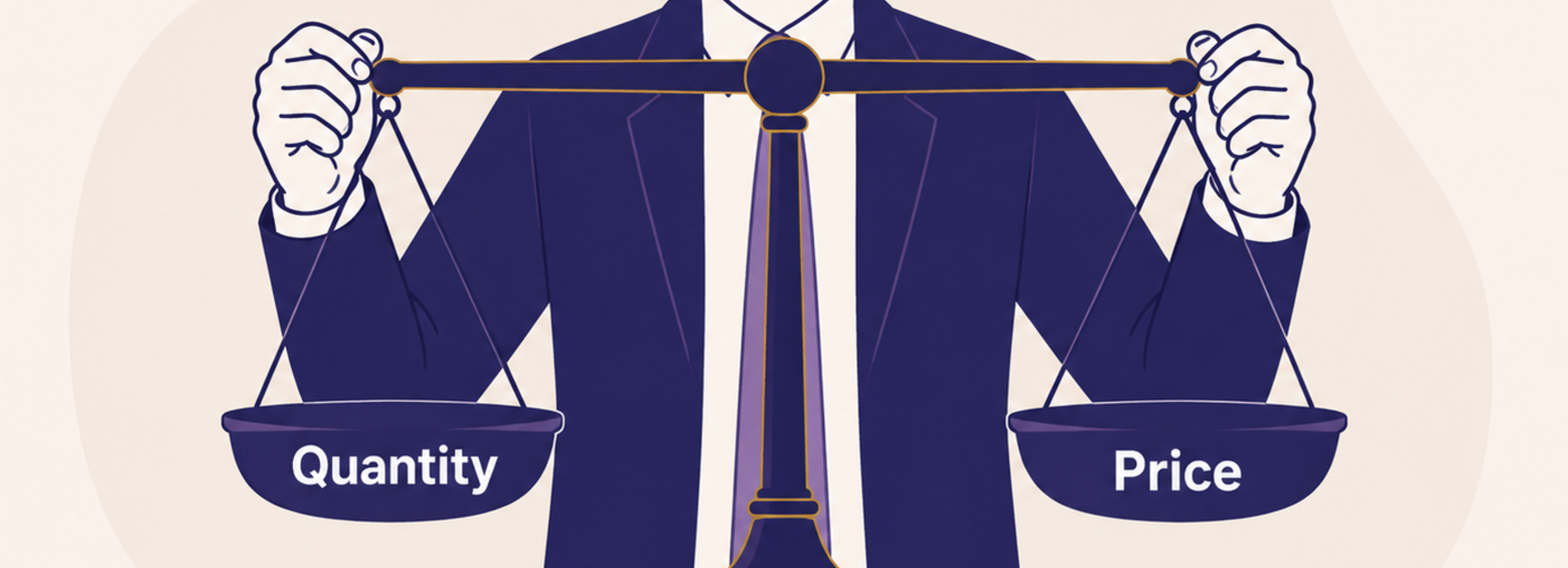
Because “Revenue” is made up of only “Price” and “Quantify”, any other strategy ultimately boils down to those two variables. Yes I needed an MBA to learn that P x Q = R.

Someday we will have these hats made…
The Default is the Default for a Reason
Let’s take an example. Let’s assume that we have the following demand curve for our products (and resulting revenue curve).
Our optimal price is $4.50. At that price, 60 people purchase and we make $270. Great.

Now what happens if we decide to either under or over charge our customers. Let’s say we wanted double the customers to be using our product; we would need to charge $1.50 to incentivize those customers. Despite having more customers, our revenue drops to $180.

Likewise, if we wanted to make our product more scarce and overcharge, we could double the price to $9.00, reduce our customers to only our top 20, and feel our revenue drop to ~$180 again.

Which brings me to an important point about monetization strategy.
Anything other than the default strategy loses revenue by definition
The only way to maximize revenue in the here-and-now is to optimally charge for each product in each segment. Undercharging and overcharging will cost real money.
So why the heck is it so popular?
The 3 good reasons to follow an adoption strategy

Adoption strategies are most famous in venture-backed technology companies4 . In this strategy, a company will underprice (sometimes to $0 or even subsidizing a market) to flood the market with customers. During that time, they often light VC money on fire5 in the hopes that they will solidify their position as the market champion. But when does this strategy actually work?
We find that it works best6 when your product or customer has any one of the following features:
Economies of Scale: Specifically, that your company’s variable costs will reduce as a result of having more customers
Network Effects: More customers increases the value of the product, and therefore willingness-to-pay (ideally of a different set of customers)
Stickiness: Customers either grow into highly retaining customers later, or the use of a product vastly reduces churn
Each of those is more nuanced than the typical definition; for example, “economies of scale” typically apply to both fixed and variable costs, but adoption strategies work best when variable costs are affected. The same can be said for network effects and sticky products; not all network effects (e.g. marketplaces) are a good place to underprice and not all sticky products (e.g. ERP solutions) should be underpriced either.
The 3 good reasons to follow a skimming strategy

Skimming strategies are most famous in luxury goods7 . To create an aura of scarcity, luxury goods companies will often severely overprice their wares, to the detriment of total revenue. The scarcity of the item is precisely what raises its value; by having fewer people with Birkins, Ferraris, and Costco Executive Cards, it makes the rest of us plebians want them more.
But there are other reasons to overprice your product. We find that a skimming strategy works best when your product or customer has any of the following:
Brand Halo: Specifically, when the value of the product goes down when more people have it, not just a “good brand”.
Limited Supply: Overpricing a good with limited supply ensures that you minimize cannibalization and resale - experts at this strategy include both Big-Pharma and Taylor Swift
High Costs: Remember how your costs don’t matter? Well…sometimes they do. When your costs become very high, your profit-optimal price starts to diverge from your revenue-optimal price.
Again, there’s more nuance here than meets the eye. Not all high priced goods have a brand halo and some relatively cheap products should still be overpriced (I’m looking at you, United Club). Likewise high costs only matter on a relative scale. The point is, it’s more complicated than what’s above.
Is an Adoption or Skimming strategy worth it?
Usually not. We usually find that executives love to play 3D chess with their strategy. They love to imagine underpricing this product so that this other product becomes a “must have” and 10 years later everyone says “wow look how smart of a business that business-person did!”

Most of the time, people overestimate the benefits of one of the strategies above and they underestimate the very real loss in revenue.
But that is not always the case, which is why we are launching this series, plus a surprise tool for you at the end.
Stay tuned for later this week when we talk about our first strategy, economies of scale.
Get in touch
Crescendo works with medium-sized software companies to improve their pricing, packaging, and promotion strategies. If you’d like to book a quick consult, reach out at info@crescendo.partners or schedule time via the button below.
1 Which is why we talk about it at the beginning 😀
2 Wikipedia identifies 32 different “pricing strategies”: https://en.wikipedia.org/wiki/Pricing_strategy
3 “Adoption Strategy” is more commonly known as a “Penetration Strategy” and, at least according to Wikipedia, a “Skimming Strategy” is also known as a “Creaming Strategy”. I am going to avoid using those monikers for obvious reasons.
4 Although importantly, only in software, not in biotech
5 Or rather LP money
6 Read: only
7 Or as fancy people like to call them, “goods”